
Politics
A Memory That Cannot Be Erased and a Late Attempt at Escape
Faiq Zaidan
Cover issue
Karam Ne’ma
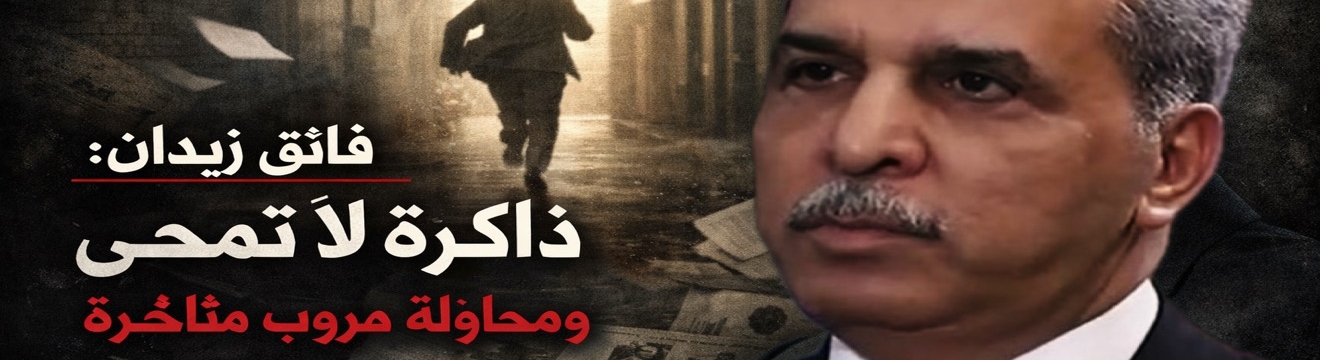
Faiq Zaidan was never outside this camp; he was one of its central pillars. His appointment to the highest judicial position did not come by coincidence, but rather within a context of direct influence exercised by Qassem Soleimani and with the clear backing of Abu Mahdi al-Muhandis, at a time when the Iraqi state was being reshaped according to the balance of power imposed by armed factions. Since then, the judiciary under his leadership has not functioned as an independent authority, but rather as an instrument within an integrated system of influence.
Iraqis have not forgotten that the judiciary, under Zaidan, became a shield protecting armed factions instead of holding them accountable. Cases involving the killing of protesters during the October uprising—including victims such as Reham Yacoub and Amjad al-Dahham—have seen no real justice, not due to lack of evidence, but due to a lack of judicial will. The same applies to the assassination of researcher Hisham al-Hashimi, which has become a stark example of how justice can be emptied of its meaning, despite the perpetrators’ links to known groups such as Kata’ib Hezbollah.
This went beyond negligence and amounted to active partnership in protecting this influence. The relationship between Zaidan and certain factions—most notably Asa’ib Ahl al-Haq led by Qais al-Khazali—was not incidental, but rather part of a broader network managing the state from behind the scenes. Judges were strategically placed in key positions to ensure the passage of certain decisions and the obstruction of others, serving the construction of what is widely referred to as the “deep state.”
Judicial decisions in electoral and political matters were not exempt from this pattern. The judiciary was used to target political opponents—particularly those outside the dominant axis of influence, whether Sunni figures or even Shia figures not aligned with it—while protection was extended to individuals implicated in clear corruption cases. This contributed to the reproduction of the same corrupt system under legal cover. Moreover, this pattern extended to judicial actions taken against certain politicians and state officials in ways that directly served Zaidan’s allies and partners, weakening their opponents and consolidating control over state institutions.
These are not isolated incidents, but part of a recurring pattern, the full extent of which will become clearer over time, as a long list of such decisions is expected to emerge in an inevitable reckoning.
Zaidan’s current attempt to portray himself as opposing armed factions does not reflect a genuine transformation, but rather a recalibration in response to shifting power dynamics. This is not a break with the past, but an attempt to escape it—especially amid regional changes and increasing international pressure, as it has become necessary to project a different narrative to the international community, particularly the United States, which closely monitors the role of the judiciary in Iraq.
Zaidan’s current attempt to portray himself as opposing armed factions does not reflect a genuine transformation, but rather a recalibration in response to shifting power dynamics. This is not a break with the past, but an attempt to escape it—especially amid regional changes and increasing international pressure, as it has become necessary to project a different narrative to the international community, particularly the United States, which closely monitors the role of the judiciary in Iraq.
The problem, however, is that what Zaidan is trying to present today fundamentally contradicts his recent history—a history that cannot be erased by statements or articles. A figure who has been among the primary protectors of armed factions and has provided them with legal cover cannot suddenly become their opponent without offering a clear account of his past role.
Iraqis do not forget, and they will not accept the rewriting of facts. The trust that has been lost through years of politicization and bias cannot be restored through rhetoric alone; it requires a fundamental change in conduct—something that has yet to be demonstrated. Attempts at repositioning are transparent, both to the Iraqi public and to international actors, and they are unlikely to convince even those who previously supported Zaidan, including Iran, which does not easily forget those it empowered.
Ultimately, the real question is not what Faiq Zaidan says today, but what he did yesterday—and whether he is prepared to confront that past. Until then, all his statements will be read as part of a political maneuver, nothing more.
Liability for this article lies with the author, who also holds the copyright. Editorial content from USPA may be quoted on other websites as long as the quote comprises no more than 5% of the entire text, is marked as such and the source is named (via hyperlink).